
Comanche VINELink County Coverage
Kansas VINE means Victim Information and Notification Everyday. It provides custody information and alerts for adult offenders reported by Kansas county jail facilities. The search and notification services are free, confidential, and voluntary. Web and telephone routes are available, with multilingual operator support.
The local boundary is crucial. Kansas VINE explicitly excludes offenders housed in Kansas Department of Corrections state prisons. A person arrested in Comanche County may be eligible for VINE coverage while held in a participating county jail. Once the custody trail enters KDOC, KASPER becomes the correct public source. Federal Bureau of Prisons and ICE custody also require their own locators.
- County-jail custody
- A local or receiving sheriff reports the custody event to Kansas VINE.
- State-prison custody
- KDOC incarceration, parole, postrelease supervision, and discharge are checked in KASPER.
- Transfer
- The person left the reporting jail for another custodian, which is not the same as community release.
- Discharge
- A later state-system endpoint showing that the KDOC supervision obligation ended.
Search Comanche VINELink Records
Begin at VINELink or call 1-866-574-8463. The official telephone service supports search, registration, and operator help. TTY service is available at 1-866-847-1298. Have enough identity information to avoid selecting the wrong person.
- Choose Kansas as the state and open the people or custody search.
- Enter the person’s name and any narrowing details the interface offers.
- Compare each possible match with known identity and case details.
- Confirm the reporting jail. A same-name record from another Kansas county may concern someone else.
- Open the match and read the custody status and latest reported event together.
A no-match result has several possible causes. Check spelling, aliases, and the selected state. Then confirm whether the person is actually in a receiving county jail, KDOC prison, federal custody, immigration custody, a municipal facility, or another state. Absence alone is ambiguous.
The Comanche County released-inmate search supplies the broader custody-specific path when the holding system is unknown.
Comanche VINELink Result Fields
VINELink is designed around current-person information and future event alerts. It is not the Sheriff’s booking ledger. The exact screen can vary, but the reported agency and custody event carry the most weight for a local release check.
| Result item | How to read it |
|---|---|
| Name and identity details | Help confirm the record belongs to the intended person. |
| Reporting agency or jail | Identifies the custodian that supplied the event. |
| Custody status | Shows the person’s last reported state in that county-jail record. |
| Last reported event | May identify release, transfer, escape, or another custody change. |
| Notification option | Allows registration while an eligible matching record is active. |
A “released” result means the reporting county jail recorded release from that custody. It does not necessarily show every historical field, rule out another warrant, or prove that no second agency assumed custody. A transfer event affirmatively points to continued custody elsewhere.
The official VINELink capture shows the Kansas search entry used for a person-specific check. Open the VINELink source to work with the current interface.
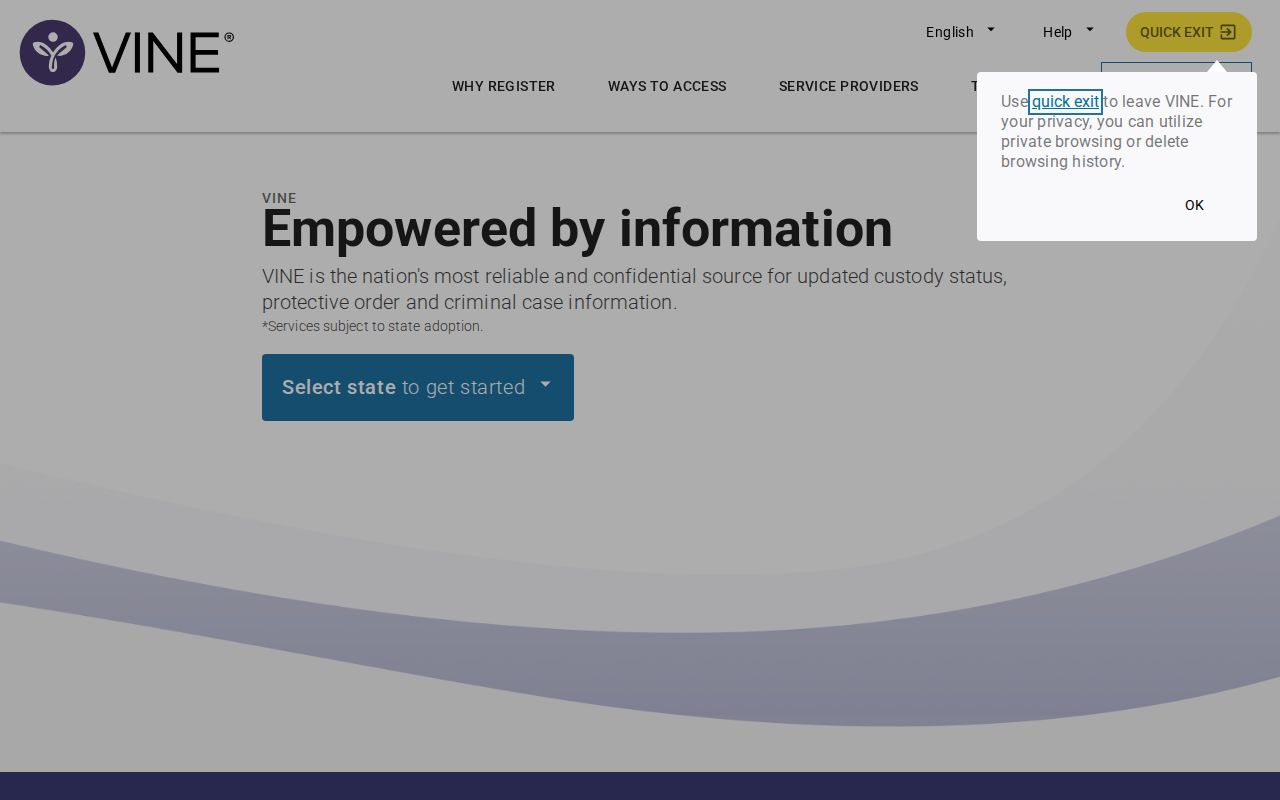
The screen is a search entry, while the matching result and reporting agency determine whether the record applies to Comanche County custody.
Register Comanche Release Alerts
Registration attaches a future alert to the selected person. Confirm the match before entering any contact destination. Do not enter private phone or email data in a public computer capture or shared browser.
- Open the matching in-custody county-jail record and select notifications.
- Choose an offered delivery method, such as telephone, email, text, or in-app notification.
- Enter the destination. For telephone registration, create a four-digit PIN.
- Review the person, reporting agency, and selected method, then confirm registration.
- When a phone alert arrives, enter the PIN followed by the pound sign to acknowledge it and stop repeat calls.
Email uses no PIN and can send a message for each status change. Official materials say alerts may concern release, transfer, or escape. Text and in-app options are statewide VINE channels. They are not a Comanche County Sheriff mobile app.
Keep the PIN private. It is used to confirm receipt of a phone notice, not to identify a person in public records. If registration fails or the match is unclear, use the VINE service number and ask for operator help.
Comanche Alerts Versus KASPER
Kansas has an unusually firm split between these tools. VINE covers county-jail custody and excludes KDOC prisoners. KASPER covers people sentenced to the custody of the Kansas Secretary of Corrections who are incarcerated, on post-incarceration supervision, or discharged, subject to its stated limits.
| Question | Correct source | Meaning |
|---|---|---|
| Did the county jail report a release or transfer? | Kansas VINE plus the Sheriff record | A county-jail custody event. |
| Is the person incarcerated in a KDOC facility? | KASPER | State imprisonment, not county detention. |
| Did the person leave prison onto supervision? | KASPER status, movement, and parole office | Release from the institution with supervision continuing. |
| Has state supervision ended? | KASPER discharge information | A later endpoint than prison release. |
A release or transfer alert can be stronger evidence than simple disappearance from a current list. Even so, the Sheriff’s release or movement record is the durable local source for the exact timestamp, release type, and destination. For state-prison status, never substitute VINE for KASPER.
Note: KASPER is updated on working days rather than acting as a live prison-door sensor.
Comanche VINELink History Limits
Official materials establish current-person search and registration for future events. They do not promise a durable historical released-result page or state how long a released county-jail record remains searchable. A person may receive a valid alert and later find that the web result has disappeared.
Preserve the alert details needed for personal reference, then request the corresponding Sheriff record when formal confirmation matters. Give the name, booking or event date range, and ask for the booking sheet, release or movement log, release date and time, release type, and destination. The Sheriff’s KORA page supplies the local request route.
A court record adds legal context. Bond, dismissal, sentence, probation, or revocation orders may explain why a custody event occurred. They do not replace the physical movement timestamp. Comanche County belongs to the 16th Judicial District, and some public documents may require the courthouse terminal or clerk rather than remote access.
Confirm Comanche VINELink Alerts
Reporting agencies supply VINE data. A notice can be delayed, corrected, or followed by another event. In an urgent safety situation, call the custodian rather than waiting for a screen to change. For Comanche County Sheriff custody, the main number is 620-582-2511.
If a local record says transported, ask for the actual receiving facility. No official source proves that all Comanche County detainees use one standing receiving jail. The receiving sheriff controls its own later release record until a transfer to KDOC or another authority occurs.
Federal cases use the BOP locator, federal court, and sometimes a USMS custody path. Immigration transfers use the ICE Online Detainee Locator and the releasing jail’s transfer entry. A BOP “Released” result means the person is no longer in BOP custody, not that every other obligation or custody hold ended.
Use Comanche Alerts Safely
VINE registration is confidential and voluntary, but safe use still depends on careful handling. Keep contact information and the phone PIN off public devices and screenshots. Compare identity details before subscribing so updates for a similar name do not cause confusion.
Do not approach a person based on an alert. If a status seems wrong, contact the reporting agency or VINE operator. For a record correction, the originating custodian controls the underlying event. KASPER accuracy issues follow the KDOC correction route instead.
The clean evidence chain is short: identify the right person, confirm the reporting jail, read the event, follow any destination, and obtain the dated agency record when needed. That sequence preserves the difference between a county-jail release, a transfer, prison release onto supervision, and final discharge.