
Comanche County Projected vs Actual Release
KASPER uses the label Anticipated release date. That field is a current sentence computation for a person in the Kansas corrections system. It is not a promise that the person will leave at a certain hour, and it does not describe a person who remains in local pretrial custody.
A bond order, sentence completion, transfer, parole release, and final discharge produce different records. The court explains legal authority. The sheriff or receiving jail records local movement. KDOC records state-prison movement and later supervision. A first agency can mark release when another agency takes custody, even though the person did not return to the community.
Find Comanche County Projected Release Dates
Identify the current custodian first. Comanche County publishes no local jail roster or projected-date calculator. KASPER applies after a person enters Kansas Secretary of Corrections custody, while Kansas VINE applies to participating county jails and excludes KDOC prisoners.
- Ask the Sheriff's Office whether the person is held locally, released, or transported. Obtain the receiving facility name if transported.
- For a KDOC sentence, open KASPER and search by name or KDOC number.
- Confirm identity with county, case, birth date, and descriptors, then read the Anticipated release date with movement and supervision fields.
- For a local jail sentence, review the court sentence and jail-credit order, then ask the actual custodian for its computation.
- For a pretrial case, review bond and later orders. Do not invent a date the court and custodian have not set.
The Comanche County release guide gives the complete search sequence when custody is uncertain.
The official KASPER search displays the state search fields after its disclaimer.
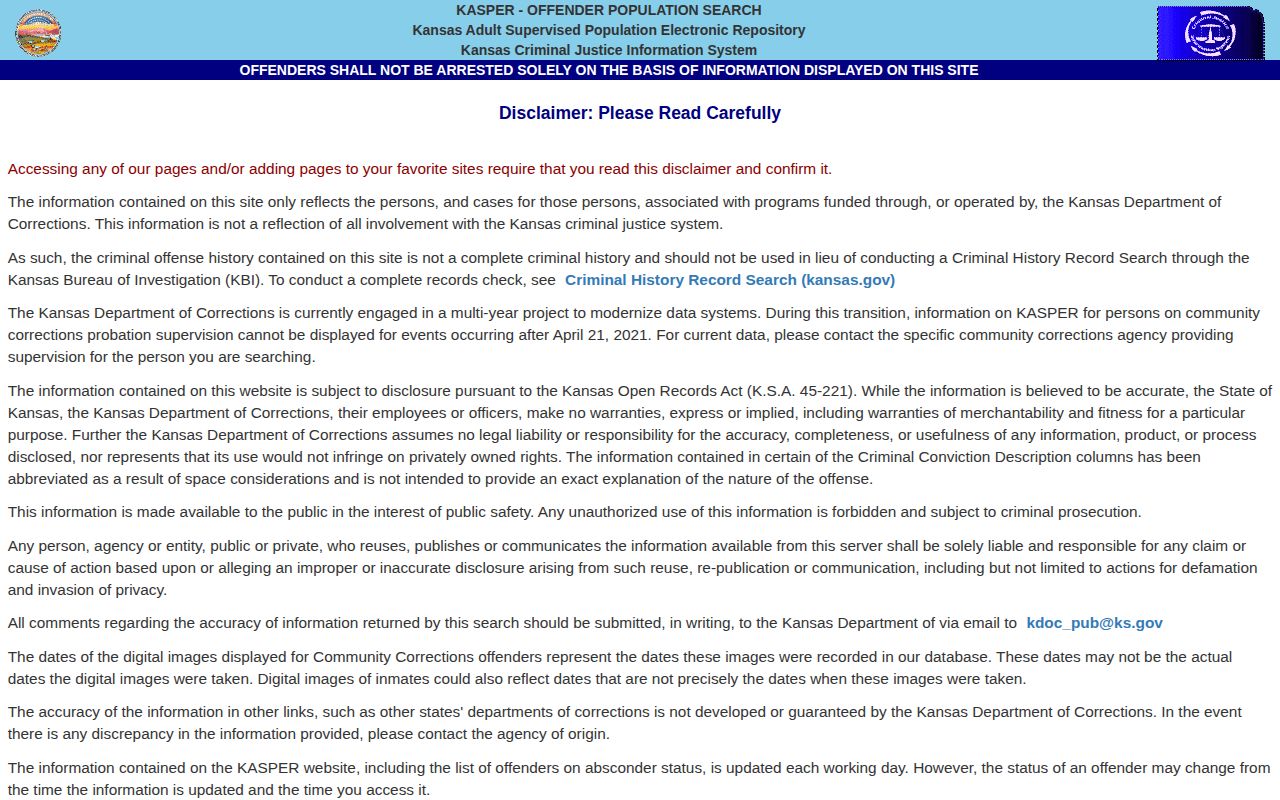
Match conviction and identity fields before using an anticipated date.
Kansas Credits for Comanche County Cases
K.S.A. 21-6821 governs good time and eligible program credits for determinate Kansas sentences. The common “85 percent” summary is incomplete. The general post-1993 determinate category allows up to 15 percent good time. Specified lower-severity crimes committed on or after January 1, 2008 can receive up to 20 percent, and eligible program credits can also apply.
Credits are earned, not guaranteed at the start. Misconduct can result in forfeiture; authorized restoration or completed programs can change the calculation. Sentence structure, jail credit, multiple cases, and court amendments also matter.
Note: Direct computation questions to 785-296-3317 and KASPER accuracy questions to kdoc_pub@ks.gov.
Indeterminate sentences differ. Under K.S.A. 22-3717, eligibility permits Board consideration but does not guarantee parole.
Why a Projected Release Date Changes
A computed date is a snapshot. The cause of a change may appear in a court record, disciplinary history, or movement record, but no single public screen necessarily explains the full calculation.
| Factor | Effect | Source |
|---|---|---|
| Good time | Moves as credit accrues, is forfeited, or restored. | KDOC computation. |
| Program credit | May reduce an eligible term. | KDOC computation. |
| Court amendment or jail credit | Changes the sentence basis. | Court order and KDOC. |
| Other sentence | Can aggregate or extend custody. | Court and KDOC records. |
| Detainer | Can change the destination when one term ends. | Movement record and receiving agency. |
| Parole action | May approve, continue, or pass an eligible case. | Board materials and KASPER. |
| Update lag | Public data may trail an internal change. | KDOC confirmation. |
KASPER updates on working days, excluding weekends. It is not a live door sensor.
Confirming a Release Date
For county-jail custody, Kansas VINE can report a release or transfer event. It excludes KDOC prisoners. The VINELink instructions explain a person-specific search and alert.
For KDOC, use KASPER movements and status. A parole-office location means release onto supervision, not final discharge. For a county sentence, ask the actual custodian for confinement and release events. The Sheriff's information line is 620-582-2511.
The court docket supports the legal reason but may not show the physical release time. Never plan a pickup only from an old anticipated date.
Comanche County Good-Time Gap
No published Comanche County jail good-time policy or weekend-release rule was verified. Applying KDOC's 15 or 20 percent framework to a locally administered jail term could produce a wrong date.
Use the court sentence and jail-credit order, identify the jail actually housing the person, and request that custodian's computed release information. If the person transfers to KDOC, use KASPER and the state framework from that point.
A facility's current instructions, not a public estimate, control release logistics.
A local record request should identify the person and the existing item sought. Helpful details include legal name and aliases, date of birth if known, booking or arrest date range, and the court or agency case number. For a county sentence, ask for the confinement or movement ledger, release date and time, release code, and transfer destination where nonexempt. Asking for an electronic copy and a cost estimate can make the request easier to process.
The Sheriff's official services page does not publish a fixed fee, production schedule, or retention term for these records. Under KORA, a response is due by the end of the third business day, but that response may provide an estimate, cite an exemption, or request clarification. It is not necessarily the finished record. The custodian determines what responsive, nonexempt material is maintained.
The Comanche County District Court lies in the 16th Judicial District. Its docket may show bond orders, a plea or trial result, sentence, jail credit, probation, revocation, and later amendments. Yet the court is not a real-time jail door log. Use the order to understand the legal basis, and use the custodian's dated movement record to confirm what physically happened.
Federal and immigration custody require separate checks. A BOP past release date means the person left BOP custody, not necessarily that all supervision or other custody ended. An ICE transfer is civil immigration custody, not a Kansas prison release. If a county record says “transfer,” get the destination before selecting any locator.
Likewise, a person can disappear from local custody and appear in KASPER later because county transfer, state intake, and public posting occur at different times. That sequence is continued custody. It should not be described as a community release merely because one roster or system no longer shows the person.
Preserve a dated copy or note of the fields consulted, especially the Anticipated release date, current location, custody type, and last movement. On a later check, compare those fields rather than relying on memory. If the date changes, the comparison helps frame a focused question for KDOC without assuming that an error occurred.
KASPER covers people sentenced to the Kansas Secretary of Corrections since 1980 who are incarcerated, under post-incarceration supervision, or discharged, subject to stated exceptions. It can show identity and physical descriptors, conviction county and case, custody type, locations, movements, parole-office information, and disciplinary data. Those companion fields help explain whether a date concerns prison, supervision, or a completed state sentence.
A current location should not be mistaken for a release destination. A state facility means the person remains in KDOC institutional custody. A parole-office entry can mean the person left the institution but remains under supervision. A discharged status is different again. Read the date beside the status and movement history, since the same person may pass through each stage.
For parole-eligible cases, the Prisoner Review Board's monthly public-comment schedule is not a release calendar. A listing can identify the person, KDOC number, offense, county and case, and facility, but it proves only that the matter is scheduled. A parole grant, later release planning, physical departure, active supervision, and final discharge remain separate milestones.
The Board can also continue a matter for more information or pass it for later reconsideration. Administrative developments may alter a release plan before the person leaves. Therefore, a hearing month or favorable process event should never replace a KASPER movement when the question is whether physical release happened.
For pretrial Comanche County custody, a court can set or modify bond, dismiss charges, issue a recognizance order, or enter another ruling. Yet processing, another warrant, or transport can affect when the person actually leaves. A court order supplies legal authority, while the release ledger supplies the dated physical event. Both records may be needed when the precise sequence matters.
Kansas VINE offers a useful county-jail check because a registered alert can report release or transfer. Its scope is narrower than a universal locator. It covers adult offenders reported by participating Kansas county jails, excludes KDOC state-prison offenders, and does not promise a permanent historical released-result page. An alert and the Sheriff's release record together are stronger than disappearance from a search result.
If VINE has no match, check spelling and the reporting jail, then consider whether the person entered KDOC, federal, immigration, municipal, or another state's custody. Absence alone remains ambiguous. A transfer notation from the Sheriff is more useful when it names the receiving agency, since it determines which system should be searched next.