
Comanche County Booking Photo Records
A booking photograph is an identifying image created in connection with an arrest or confinement. It may be attached to a booking record, but it should be named separately when requested. Kansas public-record law does not require the Comanche County Sheriff to publish such images on the web.
No local policy promising online mugshots, fixed photo fee, or image-retention period was verified. A maintained image may be requested under the Kansas Open Records Act, subject to exemptions, fees, and the records custodian's response. K.S.A. 45-221 contains closure categories that can affect access.
A booking photo is historical. It does not prove that the person is still held, that a charge led to conviction, or that the person looks the same now. Match the agency, booking date, case, and identity before attaching meaning to it.
Where Comanche County Mugshots May Appear
Each channel has a different purpose and scope. None should be treated as a complete Comanche County release-photo archive.
| Channel | Photo? | Access and limit |
|---|---|---|
| Sheriff roster or release gallery | No verified gallery | The official site publishes neither a roster nor recent-release photo feed. |
| Sheriff mobile app | No verified app | No app is advertised by the Kansas agency. |
| KORA request | Possible | Request the “booking photograph” with identity and booking details. |
| KASPER | May contain one | A KDOC image is a state corrections photo, not necessarily the county booking image. |
| KBI registry | May contain one | Only for people with a statutory registration obligation. |
| Official social or news | Sometimes | An isolated public-safety item is not a full release list. |
| Third-party category | Sometimes | May be stale, mislabeled, or retained after an official record changes. |
VINELink is useful for participating county-jail custody status and alerts, but the research does not establish it as a durable Comanche booking-photo archive. It also excludes KDOC prisoners.
No Comanche County Mugshot Gallery
The official Comanche County Sheriff site publishes no current roster, recent-release gallery, or photo stream. It also does not advertise a sheriff mobile app. A store listing or badge graphic is not enough to establish an official channel.
The Sheriff links an official Facebook account through its resources page. A social post may document one arrest or public-safety event, but a set of posts is not a systematic release record. The Comanche County 24-hour release page explains the same no-feed limitation for recent custody events.
The official Sheriff services page gives the local open-records route used when no gallery is offered.
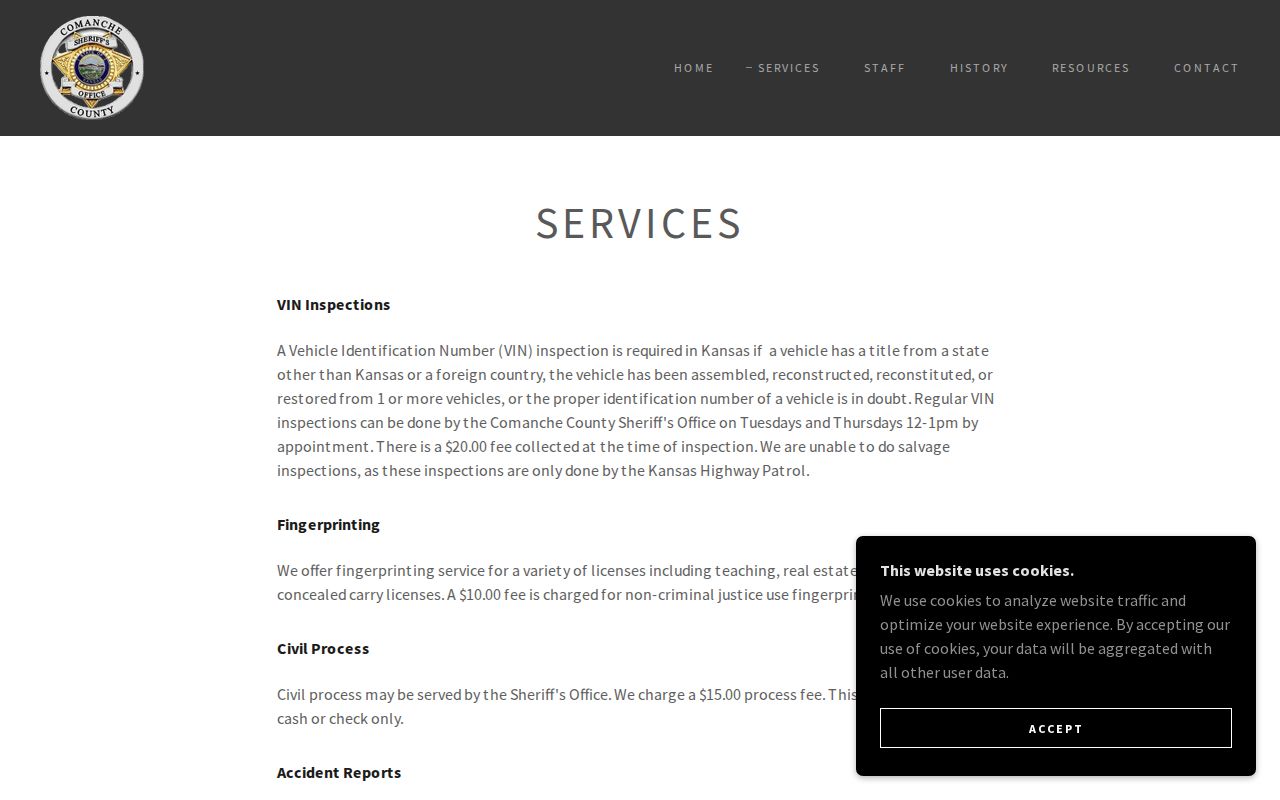
This absence concerns online publication. It does not prove that the agency maintains no booking image in its records.
Request a Comanche County Booking Photo
Use the Sheriff's official KORA form and describe an identifiable existing record. KORA does not require an agency to create a custom report or answer an open-ended question.
- Give the legal name and aliases, date of birth if known, and arrest or booking date range.
- Add the agency or case number when known, then request the “booking photograph” as a separate item.
- Specify electronic copies and ask for a cost estimate before costs are incurred.
- Deliver, mail, or submit the request through the method described on the Sheriff services page.
- Read the response for exemptions, redactions, fees, or a production estimate, and narrow the request if needed.
K.S.A. 45-218 requires a response by the end of the third business day. That is not a promise that production will be complete by then. The local site states no fixed fee or retention span.
Note: Request the release log separately if the goal also includes release time, type, or destination.
Comanche County Photo Source Limits
A KASPER record may contain a photograph for someone sentenced to KDOC. That is a state corrections image and may be older than the present record. Its displayed date may not be the capture date. It cannot be labeled as the Comanche County booking photo without proof.
The KBI Public Offender Registry can show an identifying image for a registrant. It covers only people with a statutory duty to register under Kansas law and is not a general arrest or mugshot index.
Third-party aggregators can preserve stale images, confuse Comanche County, Kansas with same-named counties in Oklahoma or Texas, and omit release codes. They should be treated only as discovery leads. No commercial mugshot or removal-service link is provided.
Local news and official social posts may show an image tied to one event. Confirm its agency, date, and record type through the underlying official record before treating it as a match.
Comanche County Expunged Photo Records
Expungement eligibility depends on the case, disposition, waiting period, and Kansas statute. The Kansas Judicial Council supplies official adult-expungement forms as a starting point. Sealed, expunged, juvenile, and other restricted court material may be excluded from public access.
An official source should be given the controlling order and enough detail to identify the image. A separate publisher may hold its own copy, so an official record change does not ensure every copy vanishes at once. No verified Kansas anti-pay-to-remove statute should be claimed, and no removal service is endorsed.
An image should be removed when a controlling public record is sealed or expunged and there is no longer a lawful, accurate basis to present it. Corrections should focus on the source record, agency, image date, and case identity.
Context for Comanche County Mugshots
Caption any official image with the agency, record type, and image date when known. A historical booking or corrections image proves only that the source associated that image with its record at that time. It does not prove present custody or current appearance.
If the actual question is whether someone was released, use the sheriff release or movement record, Kansas VINE for county-jail events, KASPER for a state sentence, and the court case for legal authority. A photograph is not release evidence.
The source hierarchy prevents a common error: finding a compelling image first and then forcing it onto the wrong person, county, or event. Identity and custody records should lead; the photo follows only after those facts match.
A complete identity check compares the legal name and aliases, birth information, arrest date, agency, and court or booking number. When the image comes from KASPER, add the KDOC number, conviction county, case, and movement history. When it comes from the KBI registry, confirm that the entry concerns a statutory registrant and not a general custody record.
Image dates also need care. A KASPER page may display a photograph without making the capture date clear. An official social post has a publication date that may differ from the booking date. A news story can reuse an older agency image. The safest caption states only the dates and source facts the official record supports.
Comanche County's no-gallery stance creates a clear workflow. First check whether the Sheriff's official navigation has changed. If no gallery is offered, submit a narrow KORA request for the booking photograph. Then use the release or movement record, not the image, to decide whether the person bonded out, completed a term, transferred, entered KDOC, or remained in another custody system.
A request can also ask for the booking sheet, release date and time, release type, destination, and nonexempt transfer notation. Naming each item keeps the photo question separate from the custody question. If the agency provides an estimate or cites an exemption, the response can be narrowed to the record and date range that matter most.
KORA access and web publication are not the same. A record may be available on request even though the agency does not post it, and a posted image may later require different treatment after an expungement or correction. The originating office remains the authority for its record, while the court controls its orders.
Commercial copies pose an added accuracy risk because they may not reflect later official changes. A search result from another Comanche County is especially hazardous here. Confirm the Kansas agency and Coldwater context before treating any image as local. Never pay a removal service merely because it claims control over an official record.
Finally, dignity and accuracy point in the same direction. Use an image only when it answers a legitimate identification or record question, provide its context, and avoid sensational labels. A person may have been released without conviction, transferred rather than freed, or discharged long after the photo was made. The image alone cannot resolve any of those facts.