
Comanche County Release Meanings
A Comanche County release record describes the end of one custody event. It does not always mean a person returned to the community. Someone may post bond, complete a local sentence, move to a receiving Kansas jail, enter Kansas Department of Corrections custody, or transfer to federal or immigration authorities. The agency that physically held the person creates the movement or release entry. A court record explains the legal basis, while Kansas VINE may report a county-jail status change. These records work together because each answers a different question.
“Bond” or recognizance usually means the person left physical custody while the case continued. “Time served” marks completion of the custodial term tied to that authority, though another warrant or supervision obligation may remain. A transfer is continued custody elsewhere. Dismissal is a case result and does not rule out another hold. Release from a KDOC institution can begin parole or mandatory postrelease supervision; final discharge comes later. A deceased custody termination must never be described as community release.
- Release
- The recorded end of custody at one facility or agency.
- Transfer
- Movement to another custodian, not freedom from custody.
- Parole
- Conditional release in an eligible indeterminate-sentence case.
- Probation
- Court-ordered community supervision that may occur without a prison release.
- Discharge
- Completion of the correctional supervision trail shown by the responsible system.
Comanche County Release Paths
The next search depends on the release code or destination. The Comanche County Sheriff's Office is the local starting point, but its official site does not publish a roster or recent-release feed. Ask whether the person is still held, was released locally, or was transported. If transported, get the actual destination before choosing another locator.
| Recorded event | What it means | Next verification |
|---|---|---|
| Bond or recognizance | Physical release while the case may remain open | Sheriff release entry and district-court bond order |
| Time served or sentence complete | The identified local term ended | Release time, court sentence, and any other hold |
| Transfer to another county | Custody continues at the named jail | Receiving sheriff and Kansas VINE |
| Transfer to KDOC | State correctional custody begins after intake | KASPER and the court case |
| Federal or ICE transfer | A separate federal custody trail begins | BOP, federal court, USMS contacts, or ICE locator as applicable |
| Parole or postrelease | Prison confinement ended, supervision continues | KASPER status and supervising office |
The records must identify the same person. Compare a middle name, date of birth, booking or case number, and agency. A photograph can help distinguish two records, but an older booking or KDOC image does not establish current appearance or custody.
Comanche County Release Record Fields
The local record may be called a booking sheet, movement history, event log, or release ledger rather than a release certificate. Request the field set that proves the event. Comanche County publishes no online field inventory or retention span, so the custodian must confirm which maintained records remain available for the date in question.
| Field | What it establishes |
|---|---|
| Booking number | Connects the release to the correct custody episode. |
| Legal name and aliases | Supports identity matching across jail and court systems. |
| Booking date and arresting agency | Identifies when and how the local custody began. |
| Charges and court number | Links the physical custody event to its legal case. |
| Bond information | Shows a possible legal basis for release, not the door time. |
| Housing facility | Identifies the agency that controlled the movement record. |
| Release date and time | Records when that custodian ended physical custody. |
| Release code or reason | Distinguishes bond, completion, transfer, or another event. |
| Destination agency | Shows whether custody continued elsewhere. |
A booking photograph may be linked to the booking file, but it should be named separately in a records request. KASPER has a broader state field set, including conviction and movement information, custody or supervision type, parole-office data, and an “Anticipated release date.” That state record is not the county booking ledger.
Request Comanche County Release Records
The Sheriff's services page links its Kansas Open Records Act form and permits delivery, mail, or online contact. Ask for an existing, identifiable record. A focused description helps staff locate the correct booking without requiring them to create a new report.
- Give the full name, aliases, known date of birth, and a narrow booking or arrest range.
- Add a booking, agency, or court case number when known.
- Name the booking sheet, movement log, release date and time, release type, destination, and booking photograph separately.
- Ask for electronic copies, nonexempt portions, and a cost estimate before work begins.
- If another jail kept the record, ask the Sheriff to identify that custodian.
408 N. Central Avenue
P.O. Box 16
Coldwater, KS 67029
Phone: 620-582-2511
Fax: 620-582-2261
Records-counter hours: not published
K.S.A. 45-218 requires a response as soon as possible and by the end of the third business day. That is a response deadline, not a promise of production in three days. Reasonable fees and advance payment may apply. No fixed local release-record fee or retention period is published, so request an estimate and ask whether the date range is still held.
Comanche Release Access Limits
Kansas open-record law starts with access and includes defined limits. K.S.A. 45-221 lists records that may or must be closed. Juvenile, medical, security, investigatory, sealed, expunged, or personally sensitive material can require withholding or redaction. When part of a file is exempt, ask for reasonably segregable public portions and the cited basis for a denial.
Expungement is a court process, not an automatic result of release. The Kansas Judicial Council forms are an official starting point. Timing and eligibility depend on the conviction and completion of the sentence or supervision. Once a controlling order limits public access, a name may disappear from court search or KASPER. A no-result screen therefore cannot prove that no earlier custody existed.
Find Released Comanche County Inmates
No single search covers every Comanche County released inmate. The official Sheriff site has neither a current roster nor a release archive, so begin with the custody system tied to the case. The 24-hour release list explains the same-day no-feed fallback, while the steps below work for a named person.
- Call the Sheriff and ask whether the person remains in its custody. If not, ask whether the entry says release or transfer and who now holds the record.
- Search Kansas VINE for a specific county-jail person. Read the reporting agency and whether the event says release or transfer.
- Use KASPER only when the case reached KDOC custody. Compare the KDOC number, identity, conviction county, case, movement, and status.
- Search the Comanche County court case for bond, disposition, sentence, probation, revocation, or discharge orders.
- If the record names federal or immigration custody, move to the matching federal locator. Do not treat transfer as community release.
- Request the physical release or movement record when a portal is absent, incomplete, or unclear.
KDOC Search for Comanche Releases
KASPER, the Kansas Adult Supervised Population Electronic Repository, is the state path for a person sentenced to the custody of the Secretary of Corrections. It is not a collection of all Kansas county bookings. KDOC says the repository generally covers Secretary-custody cases since 1980 for people incarcerated, under post-incarceration supervision, or discharged, subject to listed exceptions.
| Search or result field | How to use it |
|---|---|
| KDOC number | Use for the narrowest search when known. |
| Name and birth details | Separate people with similar names. |
| County, case, and offense | Match the KASPER result to the Comanche court file. |
| Location and movements | Distinguish prison, parole office, and past placements. |
| Custody or supervision type | Separate incarceration, supervised release, and discharge. |
| Anticipated release date | Read as a changeable computation, not a promise. |
The official KASPER entry screen shows the disclaimer that must be accepted before a search.
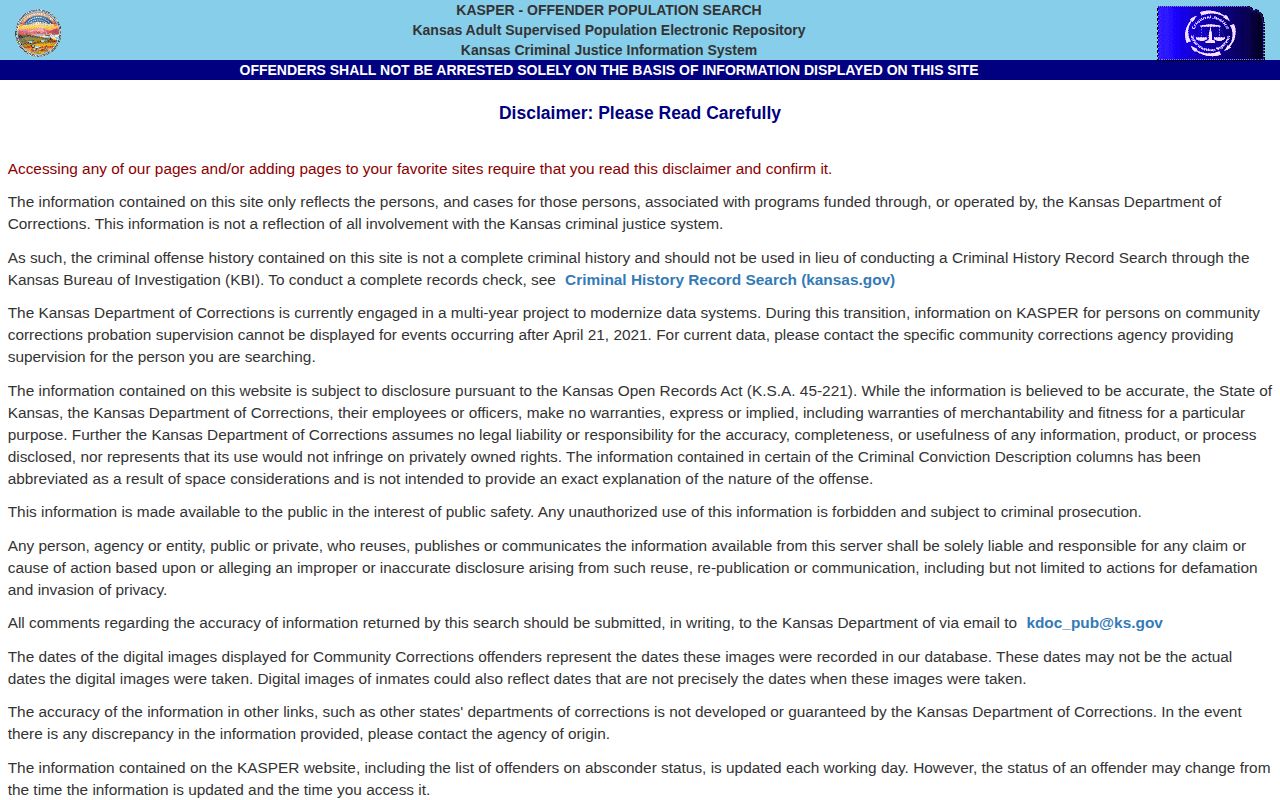
After entry, review the whole record. An institution indicates state incarceration. A parole-office or supervision type can mean prison release with supervision still active. “Discharged” is the KDOC completion marker, although it does not address an unrelated custody system.
Comanche County Has No Release Feed
The official Kansas Sheriff site publishes no inmate search, jail roster, booking list, 24-hour list, 72-hour list, or mugshot gallery. It also advertises no Sheriff mobile app. These are findings about online publication, not claims that no release records exist. Do not substitute results from Comanche County in Texas or Oklahoma, and do not assemble social posts into a supposedly complete list.
The Sheriff's website capture confirms the local agency and its navigation.
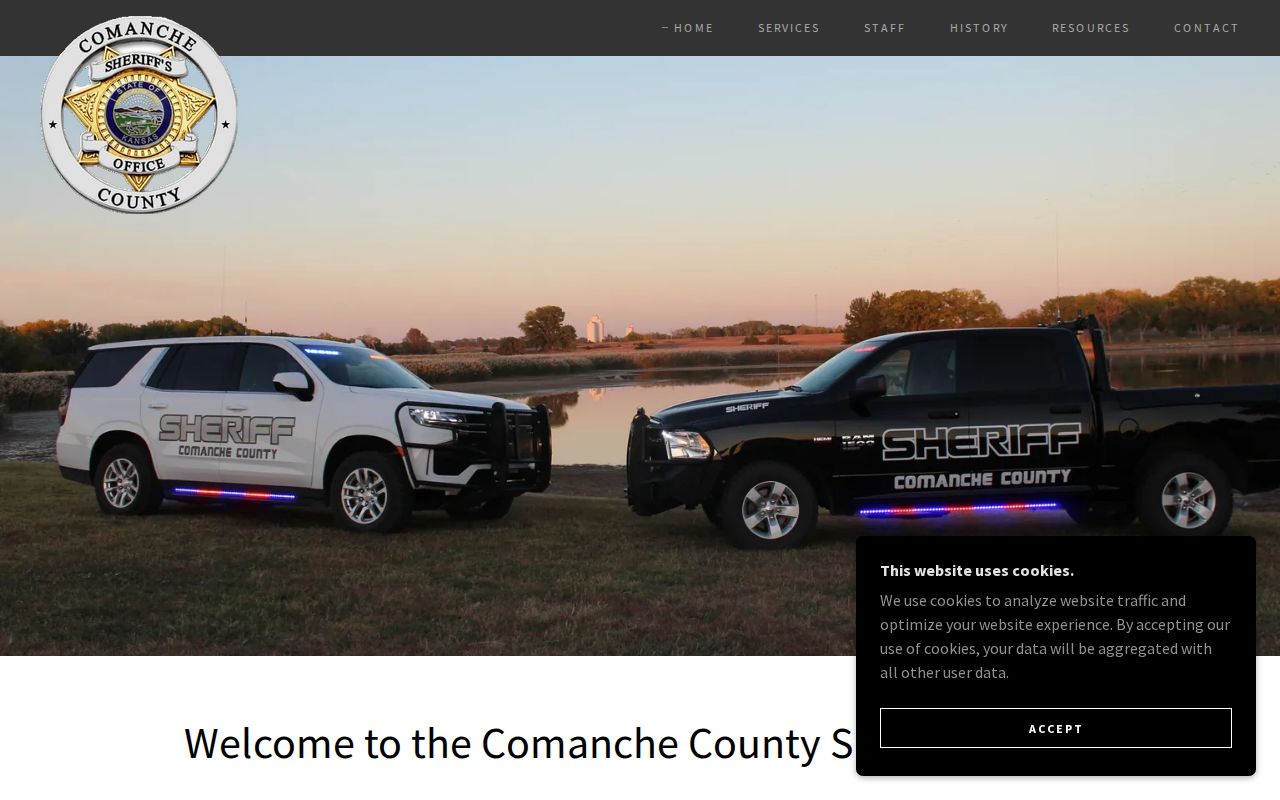
For a date range, ask whether the Sheriff maintains an existing release log that can be produced. KORA ordinarily provides maintained records and does not force creation of a custom report. A receiving jail may have its own tool, but it applies only after the actual facility is identified.
Comanche Release Supervision Checks
Parole, postrelease supervision, and probation are different. KASPER is the public route for KDOC incarceration and post-incarceration supervision. A person tied to a parole office has left prison but has not necessarily reached final discharge. Comanche County is served by the Dodge City Parole Office. The court record is essential for probation because KASPER warns that community-corrections probation events after April 21, 2021 cannot be displayed.
The full Parole & Probation route pairs KASPER with the Prisoner Review Board, court docket, and correct field office. A hearing schedule is not a release decision, and a grant is not the same as physical movement or later discharge.
Comanche County VINE Release Alerts
Kansas VINE covers participating county-jail custody and expressly excludes KDOC prisoners. Search one person after selecting Kansas, match the reporting agency, and register for a release, transfer, or escape alert while a matching record is active. Phone alerts use a four-digit PIN followed by the pound sign for acknowledgment. Email alerts do not use that PIN. VINE is an event and notification channel, not a durable archive of all releases.
A release alert supports what the county jail reported, but it does not rule out another warrant or a transfer to a different authority. If the result later disappears, pair the alert with the Sheriff's release record. Use the VINELink Check for the complete registration path.
Compare Comanche Release Systems
Start with the system that owned the custody event. Crossing systems without a transfer record creates false conclusions.
| System | What it covers | Released-person evidence |
|---|---|---|
| Comanche County Sheriff | Local arrest and holding trail | Phone confirmation and requested release or movement record |
| Kansas VINE | Participating county-jail events | Reported release or transfer alert for one person |
| KASPER | KDOC custody, supervision, and discharge | Movement, supervision location, or discharged status |
| District Court | Legal case and orders | Bond, disposition, sentence, probation, and discharge context |
| BOP Locator | Federal BOP population, generally from 1982 | “Released” location or past BOP release date |
| ICE locator | ICE detention and limited recent-release visibility | Current result or a record within the locator's stated limits |
The BOP Inmate Locator treats “Released” as no longer in BOP custody, not as proof that all supervision or other custody ended.
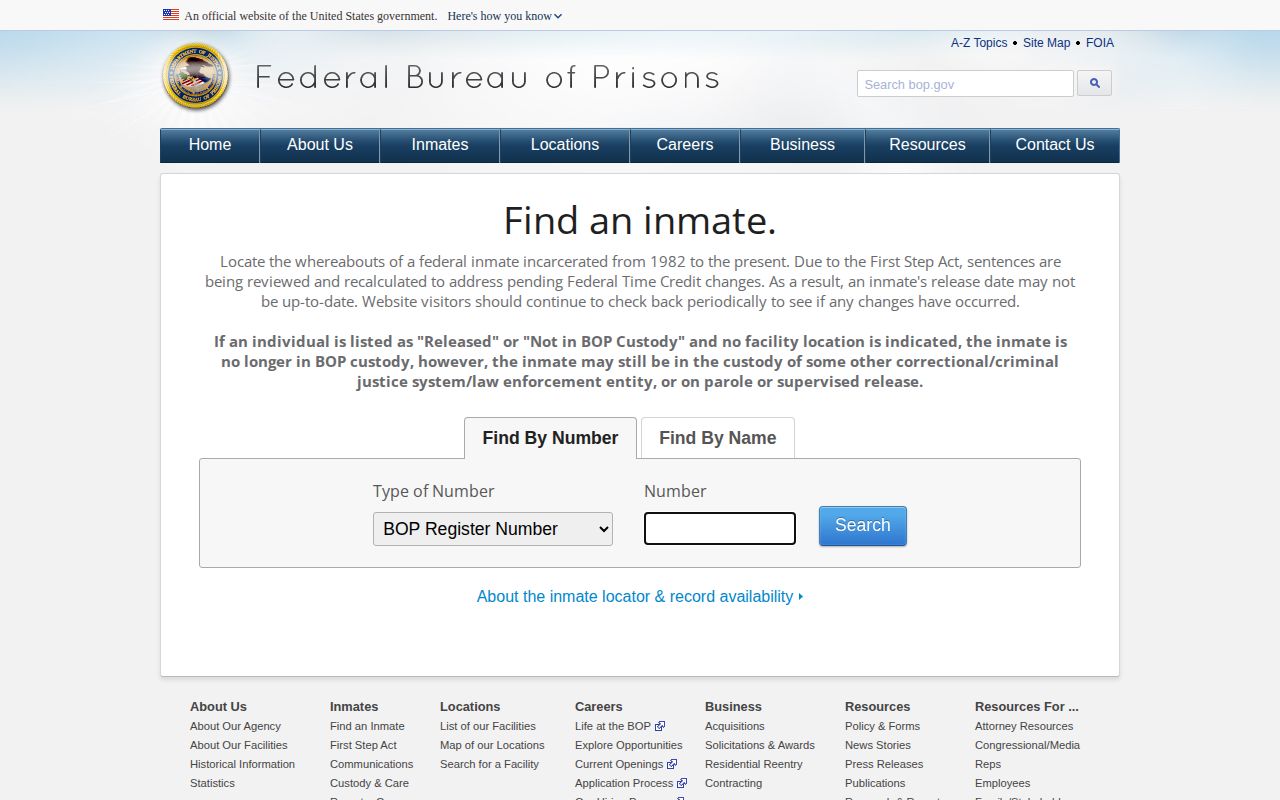
For ICE, use the official locator only after a transfer or detainer points to immigration custody. A no-result can reflect identity, age, timing, safety, or coverage limits.
Comanche County Release Facilities
The Comanche County Sheriff's Office is the verified local custody starting point. No standing receiving-jail contract was verified, so a receiving Kansas county jail applies only when the Sheriff names one in a specific case. KDOC controls state-prison records, while the Dodge City Parole Office serves supervised Comanche County releasees.
No BOP prison or ICE detention site was identified inside Comanche County. The federal BOP path and ICE locator path are included only for a case-specific federal transfer. Their presence does not imply a local facility exists.
KDOC Release Questions from Comanche
Kansas provides two direct correction channels. Send KASPER accuracy concerns to kdoc_pub@ks.gov. Direct official sentence-computation questions to KDOC at 785-296-3317. These routes serve different issues: one concerns the public repository, while the other concerns the underlying date calculation.
KDOC's state-facility release guidance says remaining account funds, transportation, civilian clothing, and reporting instructions are handled before a state release. Those details must not be presented as Comanche County jail policy. No local property-release process, exit point, release hour, or transportation rule was verified.
Comanche Court Release Corroboration
Comanche County District Court belongs to the 16th Judicial District. The statewide portal can show case events, but remote access does not guarantee every public document. The courthouse terminal and local clerk remain the fallback. Sealed, expunged, juvenile, and other restricted material is excluded from public access.
The clerk's official page provides the local access point.
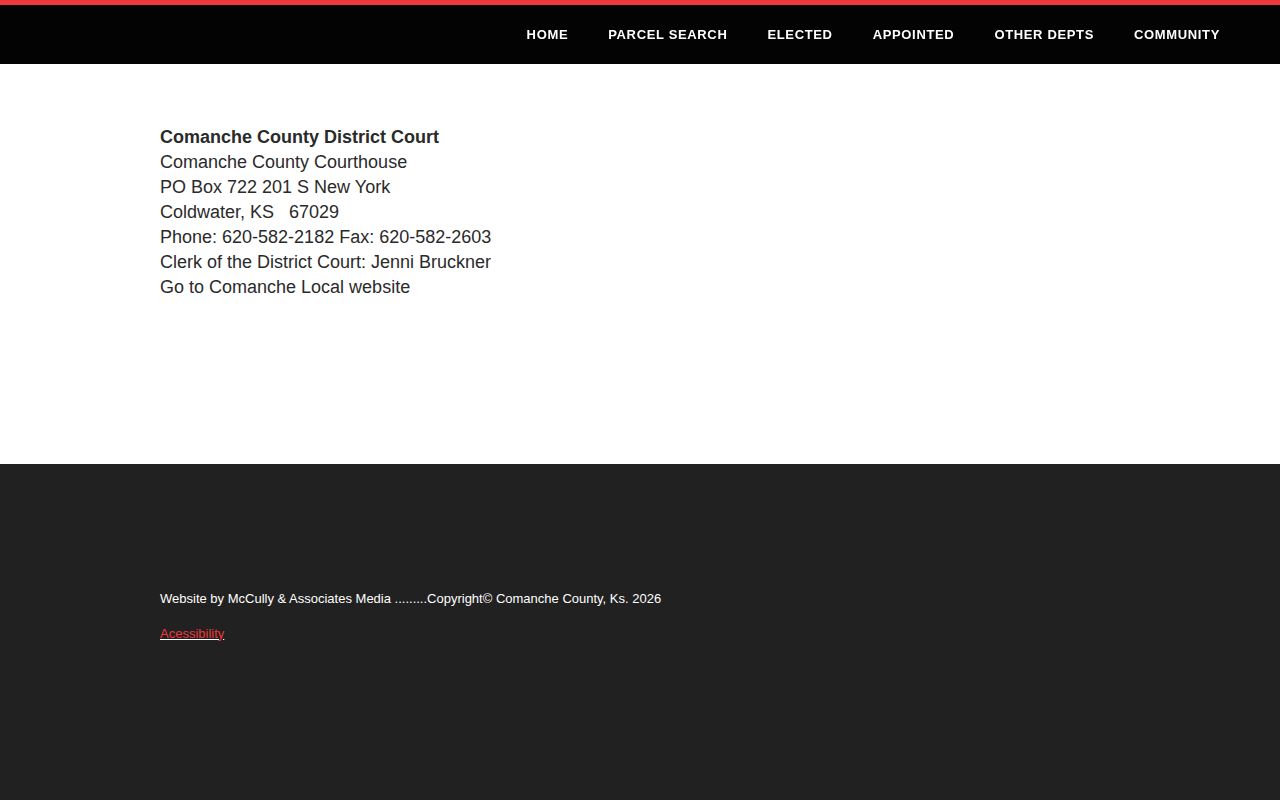
Read the docket chronology, not just the original charge. A bond order may authorize release, while the jail entry proves when release occurred. A sentence explains the legal term, while KASPER shows correctional status. Court evidence is durable corroboration, not a real-time jail door record.